In 2018, the UK National Screening Committee (UK NSC) recommended increasing the sensitivity of the bowel cancer screening faecal immunochemical test (FIT).
This means reducing the threshold for how much blood in a screening sample needs to be present to trigger a referral for more tests.
The NHS Bowel Cancer Screening Programme in England is now lowering the threshold from 120 micrograms of haemoglobin per gram of faeces (µg Hb/g) to 80µg Hb/g. By lowering the test threshold, the programme will have the potential to detect more polyps (abnormal growths that can develop into cancer over time) and more cancers.
How bowel cancer screening works
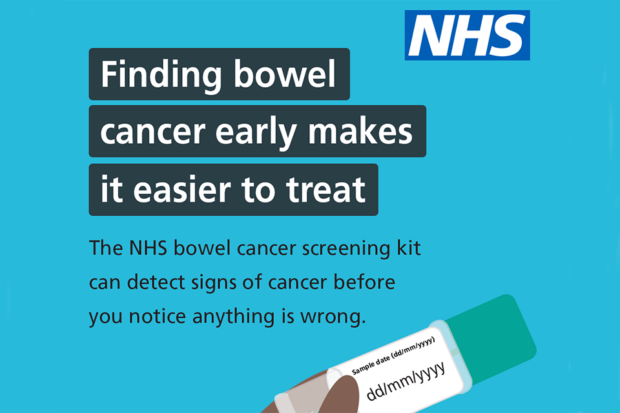
The NHS Bowel Cancer Screening Programme invites people aged 50 to 74 years for bowel cancer screening every 2 years by sending them a FIT home test kit in the post.
People use this kit to return a sample of faeces (poo) for testing in a laboratory. If blood is found in the sample at levels above the test threshold, then the programme invites the person for more tests. These tests can include a colonoscopy – an examination of the lining of the large bowel during which any polyps can be removed.
Test thresholds across the UK
While the current FIT threshold for referral in England and Northern Ireland is 120 μg Hb/g, Wales has already lowered its threshold for referral to 80μg Hb/g and Scotland has always set its FIT threshold at 80μg Hb/g.
The threshold in England is being lowered to 80μg Hb/g in a phased rollout that should be completed by March 2028.
Lowering the test threshold will mean more people will be referred for follow-up diagnostic tests.
Likely consequences of reducing the FIT threshold
The increase in referrals for follow-up tests will increase demand on services.
To help determine the impact of reducing the FIT referral threshold, the Department of Health and Social Care commissioned the Sheffield Centre for Health and Related Research (SCHARR) at the University of Sheffield to produce a report on the predicted health and resource consequences.
Download and read the full SCHARR report.
Using data analysis and statistical modelling, the SCHARR authors estimated, in the short term, that reducing the FIT test threshold to 80μg Hb/g would result each year in 36% more positive screening results.
This would lead to the detection of an estimated 2,017 more high risk polyps and 663 more bowel cancers.
In the longer term, after 25 years of bowel cancer screening at a FIT threshold of 80μg Hb/g, they estimated there would be 867 fewer bowel cancer deaths each year.
Initially, more cancers would be detected. Then, the prevalence of bowel cancer would decrease as more polyps are detected and removed, preventing bowel cancers developing.
Next steps
Lowering the threshold of FIT to 80µg Hb/g will result in a significant increase in workload for the screening programme. But the benefits are clear as more bowel cancers will be detected and more will be prevented.
The phased roll out across England will enable all screening centres to prepare for the change, and to recruit the staff needed to ensure the programme can be delivered sustainably within the appropriate waiting times.
You can read more about the benefits of bowel screening here: Wealth of evidence highlights the benefits of bowel cancer screening – UK National Screening Committee.
Keep up to date
The UK NSC blog provides up to date news from the UK NSC. You can register to receive updates direct to your inbox, so there is no need to keep checking for new articles. If you have any questions about this blog article, or about the work of the UK NSC, please email uknsc@dhsc.gov.uk.
Recent Comments